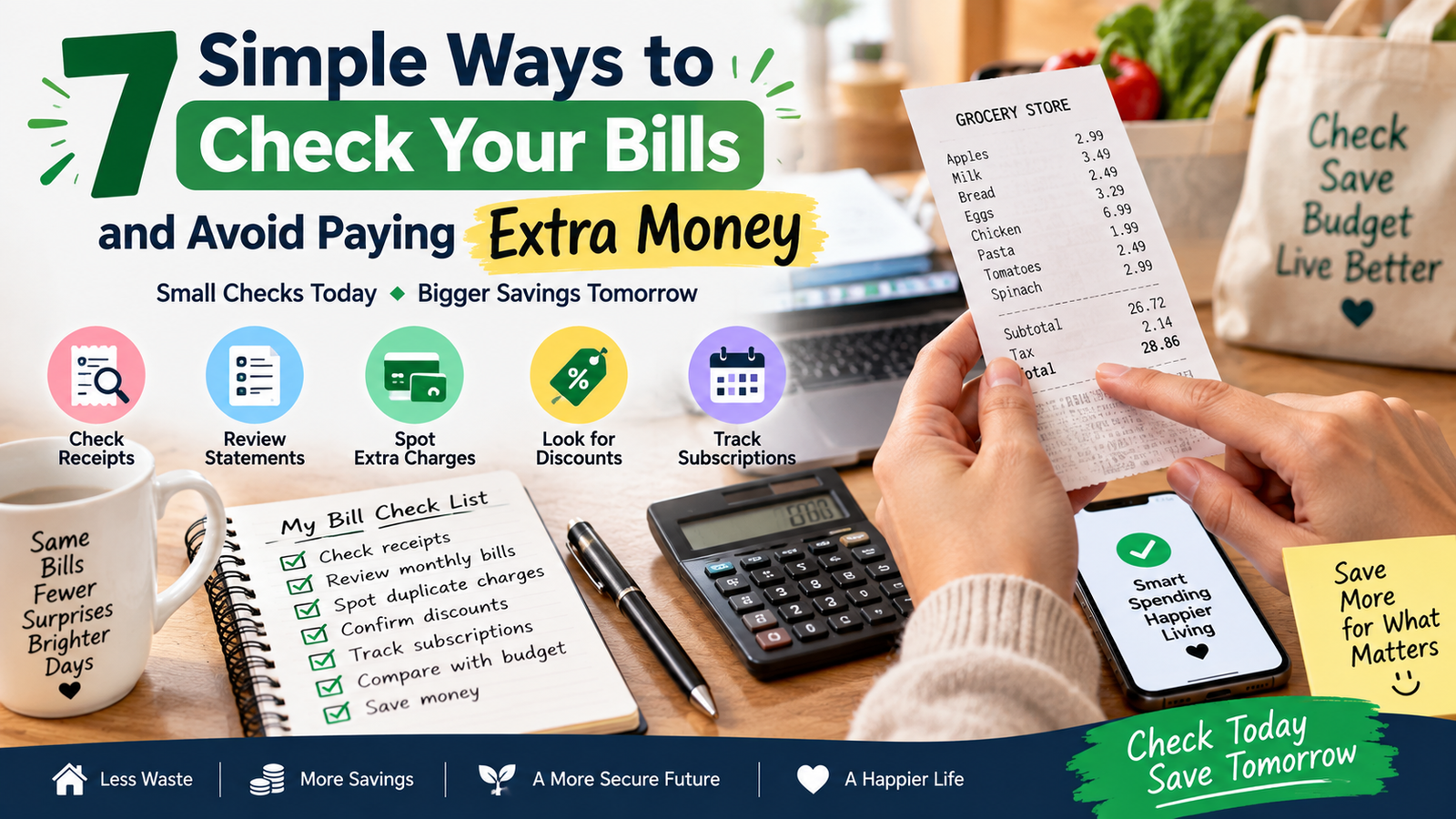
7 Simple Ways to Check Your Bills and Avoid Paying Extra Money
Small billing mistakes can quietly cost you money. A grocery receipt may contain the wrong price, a restaurant bill may include an item you did not order, or a monthly subscription may renew when you no longer use it.
Learning how to check your bills before and after paying can help you catch these problems early. You do not need complicated financial skills or hours of paperwork. A few careful checks can prevent unnecessary charges and make your spending easier to control.
Whether you are reviewing a grocery receipt, utility statement, medical bill, credit card statement, or monthly subscription, the goal is the same: pay only what you actually owe.
Here are seven simple ways to make bill checking part of your regular money routine.
1. Check Your Bills and Receipts Before Leaving the Store
One of the easiest money-saving habits is checking your receipt before you leave the checkout area.
It only takes a few seconds, but it can help you spot mistakes while the transaction is still fresh.
Look for:
- Incorrect item prices
- Duplicate items
- Missing discounts
- Incorrect quantities
- Coupons that were not applied
- Products you did not purchase
- Promotions that were advertised but not reflected
For example, suppose a product was marked on the shelf at $4.99 but rings up at $7.99. If you notice the difference immediately, you can politely ask the cashier to verify the price.
Do not feel pressured because other customers are waiting behind you. Taking a moment to check your bills can save more money than rushing away and discovering the problem later.
Keep important receipts, especially for expensive purchases, returns, warranties, or purchases where you received a discount.
Receipts can also help you compare actual spending with your monthly budget.
Simple habit: Before putting your receipt away, quickly check the total, number of items, discounts, and any unusual charge.
2. Compare the Bill With What You Actually Bought or Used
A bill should match the product or service you received.
This sounds obvious, but it is easy to overlook a charge when you have several purchases or accounts to manage.
When you check your bills, compare the statement with your original receipt, order confirmation, service agreement, or account records.
For example, if you ordered three items online, your final charge should reflect those three items plus clearly disclosed shipping, tax, or other applicable charges.
For a restaurant bill, check whether every item belongs to your table. If a service charge or other fee appears, make sure you understand what it represents.
For a utility bill, compare your current usage and charges with previous statements. A large change does not automatically mean there is an error, but it is worth investigating if the amount seems unusual.
The Consumer Financial Protection Bureau recommends reviewing credit card statements carefully because billing mistakes can occur, including incorrect charges and fees.
Simple habit: Keep digital receipts and order confirmations in your email so you can compare them when a bill arrives.
3. Look Carefully for Duplicate or Unfamiliar Charges
Duplicate charges are easy to miss when you make several purchases from the same company.
You might see the same transaction twice, an unexpected service charge, or a charge from a company you do not immediately recognize.
This is why you should check your bills instead of only looking at the final balance.
Pay special attention to:
- Repeated transactions
- Unfamiliar merchants
- Unexpected service fees
- Charges from old subscriptions
- Automatic renewals
- Fees you were not expecting
- Payments that should have already been credited
If you do not recognize a charge, do not automatically assume it is fraud. First check your receipts, email confirmations, family purchases, and recurring subscriptions.
If you still cannot identify the transaction, contact the company or your financial institution promptly.
For credit card billing errors, the CFPB recommends reviewing statements and following the issuer’s dispute process when you find a problem.
Simple habit: Once a week, scan your recent transactions for anything duplicated, unfamiliar, or higher than expected.
4. Check Discounts, Coupons, and Promotional Prices
A discount only helps if it actually appears on your receipt or final bill.
Stores and websites may advertise promotions such as percentage discounts, buy-one-get-one offers, member pricing, digital coupons, or limited-time deals.
Before paying, check your bills to make sure the expected discount was actually applied.
For example:
- A $50 item with a 20% discount should show the appropriate reduced price.
- A digital coupon should appear as a discount when its terms are met.
- A sale price should be reflected if the product qualifies.
- A membership discount should appear if your account is eligible.
If the discount is missing, ask the retailer to verify it before completing the transaction when possible.
For online purchases, take a screenshot of a promotional offer when it is important to the final price. Keep the confirmation email until you are certain the transaction is correct.
Simple habit: Compare the advertised price with the price shown on your receipt before considering the transaction finished.
5. Review Recurring Bills and Automatic Payments
Recurring charges deserve special attention because they can continue for months without you noticing.
Examples include:
- Streaming services
- Gym memberships
- Software subscriptions
- Cloud storage
- Phone plans
- Internet service
- Insurance payments
- Membership programs
When you check your bills, look for subscriptions or services you no longer use.
The Federal Trade Commission advises consumers to monitor credit and debit card statements after signing up for free trials or subscriptions because automatic renewals can lead to unexpected charges.
Make a simple list of your recurring payments and review it once a month.
If you find something you no longer need, check the company’s cancellation instructions and keep confirmation of your cancellation.
If a company continues charging you after you properly canceled, contact the company and, when appropriate, your card issuer about the charge. The FTC recommends keeping records of cancellation requests and related communications.
Simple habit: Set one monthly reminder called “Subscription Check” and review every recurring payment.
6. Read Medical and Service Bills Carefully
Medical bills and service invoices can be more complicated than grocery receipts, but they still deserve careful review.
Before paying a large medical bill, check your bills against the services you actually received and any insurance information available to you.
Look for:
- Services you did not receive
- Duplicate charges
- Incorrect quantities
- Insurance payments that are missing
- Incorrect patient information
- Unexpected out-of-network charges
- Amounts that do not match your records
The CFPB recommends checking whether medical charges are accurate, whether they reflect services received, and whether insurance payments have been properly reflected. It also advises asking for an itemized list if something does not look right.
Do not ignore a questionable bill simply because it looks complicated.
Contact the provider’s billing department and ask for an explanation of any charge you do not understand.
For other services, such as home repairs or maintenance, compare the final invoice with the original estimate or agreed scope of work.
Simple habit: Never pay a large unfamiliar invoice without first understanding what each major charge represents.
7. Compare Your Bills With Your Monthly Budget
Bill checking becomes much more useful when you connect it to your overall budget.
After you check your bills, record the important amounts in your monthly spending plan.
This helps you identify patterns such as:
- Rising utility costs
- Increasing subscription expenses
- Higher insurance premiums
- Unusual shopping spending
- Repeated service fees
- Bills that are consistently higher than expected
If you already have a monthly budget, compare your actual expenses with the amounts you planned to spend.
Our guide on how to create a monthly budget explains how to organize income, fixed expenses, variable spending, and savings goals.
You can also use our guide to check your financial outgoings and income when reviewing your wider financial picture.
The goal is not to spend hours checking every transaction. The goal is to notice meaningful differences before they become expensive habits.
Simple habit: Choose one day each week to review recent receipts and bills, then make a short note of anything that needs attention.
A Simple Bill-Checking Routine You Can Follow
You do not need a complicated system to protect your money.
Use this five-minute routine:
Step 1: Gather your receipts and recent bills.
Keep digital receipts, invoices, and important statements in one easy-to-find location.
Step 2: Check the total.
Make sure the final amount looks reasonable compared with what you purchased or used.
Step 3: Scan individual charges.
Look for duplicate items, unfamiliar transactions, missing credits, and unexpected fees.
Step 4: Check discounts and payments.
Confirm that coupons, promotional prices, insurance payments, or previous credits were applied correctly.
Step 5: Take action quickly.
If something looks wrong, contact the retailer, service provider, or financial institution instead of ignoring it.
When you consistently check your bills, small mistakes are easier to catch before they become repeated expenses.
How Much Money Can Bill Checking Save?
There is no guaranteed amount because savings depend on the type and frequency of billing errors you encounter.
However, the value can add up when you catch:
- A missed $10 discount
- A duplicate $25 charge
- An unwanted $15 monthly subscription
- An incorrect service fee
- A billing error on a larger invoice
A single correction may seem small, but repeated charges can become significant over several months.
That is why reviewing your bills should become a regular money-management habit rather than something you do only when a charge looks unusually high.
You can also combine this habit with other money-saving strategies in our guide to smart ways to save money every day.
What to Do When You Find a Billing Error
Do not ignore an error once you notice it.
Start by collecting evidence such as the receipt, invoice, order confirmation, statement, email, or cancellation confirmation.
Then:
- Identify the exact charge you believe is incorrect.
- Contact the business or financial institution.
- Clearly explain what appears to be wrong.
- Provide supporting documents when requested.
- Write down the date and details of your conversation.
- Keep copies of emails or dispute documents.
- Follow up if the issue is not resolved.
For credit card billing errors, federal rules provide specific procedures for disputing certain errors, and the CFPB advises consumers to follow the instructions on their statement and keep records.
For U.S. credit card billing errors covered by the Fair Credit Billing Act, send a written billing-error notice to the card issuer’s designated address within 60 days after the statement showing the error was sent. Check your card agreement and the issuer’s dispute instructions, because not every transaction dispute follows the same process. Keep copies of your letter and supporting documents.
For unauthorized electronic transactions, the CFPB also recommends contacting your bank or credit union promptly because consumer protections and deadlines can apply.
Final Thoughts
You do not need to become a financial expert to avoid unnecessary charges.
A few minutes of careful checking can help you catch incorrect prices, duplicate charges, missing discounts, unwanted subscriptions, and billing mistakes.
The easiest approach is to check your bills consistently instead of waiting until a charge becomes a serious problem.
Make receipt checking a habit at checkout, review recurring payments monthly, and compare important bills with your records and budget.
Small checks can protect your money, improve your spending awareness, and make your monthly budget easier to manage.
FAQs
1. Why should I check my bills before paying?
Checking your bills can help you catch incorrect prices, duplicate charges, missing discounts, unexpected fees, and services you did not receive.
2. How often should I check my bills?
Review receipts when possible, scan financial transactions weekly, and review recurring bills and major statements at least once a month.
3. What should I do if I find a wrong charge?
Contact the business or financial institution, explain the error clearly, and keep receipts, statements, emails, and other supporting records.
4. Can checking receipts really save money?
Yes. Finding a missed discount, duplicate charge, or unwanted recurring payment can prevent money from leaving your account unnecessarily.
5. Should I keep my receipts?
Keep receipts for expensive purchases, returns, warranties, disputed transactions, and purchases where the final price may need verification.
6. How can I spot unwanted subscription charges?
Review recurring transactions and compare them with the subscriptions you currently use; cancel services you no longer need and keep cancellation records.
7. What should I check on a medical bill?
Compare the bill with the services received, insurance information, payments already made, and an itemized list of charges when necessary.
8. Should I check bills even when the total looks normal?
Yes. An apparently normal total can still contain duplicate charges, missing discounts, or recurring payments that you no longer want.
1 thought on “7 Simple Ways to Check Your Bills and Avoid Paying Extra Money”