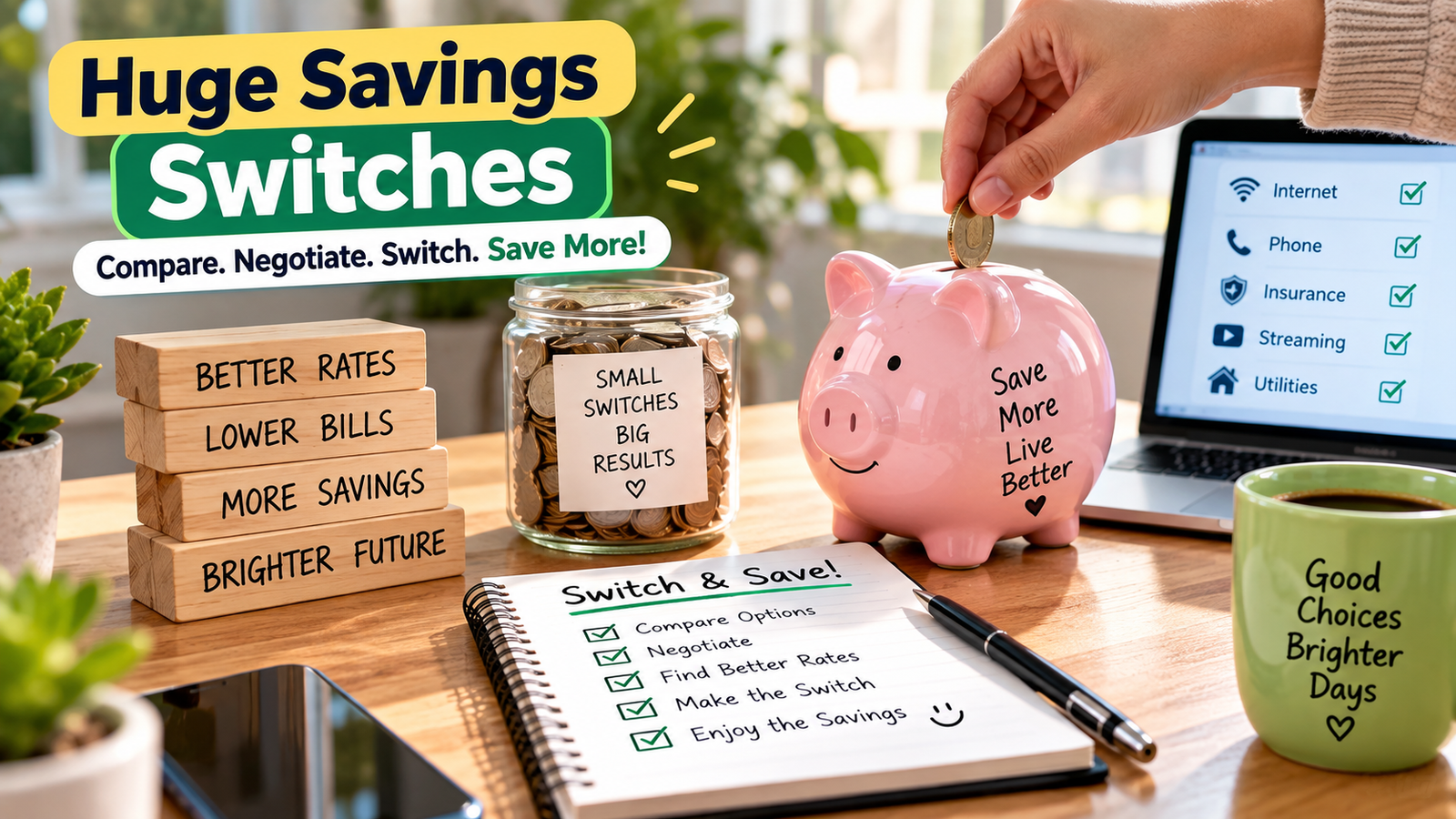
Huge Savings Switches: 9 Powerful Ways to Cut Your Everyday Costs
Paying the same company year after year can feel convenient, but convenience can sometimes become expensive.
Your internet bill may increase. Your insurance renewal may come with a higher premium. A subscription you rarely use may continue charging your card. A service provider may offer a better deal to new customers while your old rate stays unchanged.
This is where huge savings switches can make a difference.
A savings switch means looking at what you currently pay, checking what competitors offer, asking your existing provider for a better deal, and switching when the numbers make sense.
The idea is simple: if a company is not offering a competitive rate, be willing to hop to another provider.
You do not need to switch everything at once. Start with recurring expenses that are large enough to matter and easy enough to compare.

What Are Huge Savings Switches?
Huge savings switches are deliberate changes from an expensive product, service, plan, or provider to a lower-cost option that still meets your needs.
The switch could involve:
- Internet service
- Cell phone plans
- Insurance
- Streaming subscriptions
- Banking services
- Energy plans where alternatives are available
- Software subscriptions
- Gym memberships
- Travel services
- Household services
- Retail memberships
The goal is not simply to choose the cheapest option.
A cheaper plan may have fewer features, higher fees, weaker service, or a contract that costs more later. Compare the total cost, terms, fees, and benefits before making the change.
The CFPB recommends comparing financial products and services by looking at costs, features, and terms instead of relying on a single advertised number.
Why Switching Providers Can Save More Than Cutting Small Expenses
Cutting small purchases can help, but recurring bills deserve special attention because one successful change can reduce your expenses month after month.
For example, saving $25 a month on a recurring service equals $300 over a year.
Saving $50 a month equals $600.
That is why reviewing recurring bills can sometimes save more money than focusing only on small everyday purchases.
Start by reviewing your recurring charges.
Look at your bank and credit card statements from the last few months. Make a list of subscriptions, memberships, insurance payments, phone bills, internet bills, and other recurring expenses.
Then ask one question:
“Am I still getting enough value for what I am paying?”
If the answer is no, it may be time to negotiate or switch.
9 Huge Savings Switches to Try
1. Compare Your Current Rate With Competitors
Before calling your provider, find out what similar companies are charging.
Check the actual price, promotional period, fees, contract length, included features, and cancellation rules.
Do not compare only the introductory price.
A plan advertised at $40 per month may become $75 after a promotional period, while another plan may cost $55 without a temporary discount.
The real comparison is the total cost over the period you expect to use the service.
This is one of the easiest huge savings switches because research gives you information you can use when negotiating.

2. Negotiate Before You Switch
You do not always have to leave your current provider.
Call customer service and politely explain that you are reviewing your options.

You can say:
“I’m comparing similar plans because my current price has become too high. Are there any lower-cost plans, discounts, or promotions available for my account?”
Ask about:
- Loyalty discounts
- Current promotions
- Lower-cost plans
- Bundle discounts
- Annual payment discounts
- Plan changes
- Waived fees
- Retention offers
Do not threaten to leave unless you are actually prepared to leave.
The goal is to understand what the company can offer before you make your decision.
3. Switch at the Right Time
Timing can affect the price you receive.
Some useful times to check for better offers include:
- Before a new financial year
- Major holiday promotions
- Major retail sale events
- End of season
- End of a promotional period
- New model launches
- Clearance periods
- Inventory cleanup
- Low-demand periods
- Special events
- Bundle promotions
- Subscription renewal dates
The exact timing varies by industry.
For example, new products can affect pricing on older models, while seasonal businesses may offer promotions during slower periods.
This makes timing an important part of huge savings switches.
4. Use New Model Launches to Your Advantage
When a newer model arrives, older models may receive discounts.
This can apply to products such as phones, computers, appliances, televisions, and other technology.
If you do not need the newest version, compare the older model with the new one.
You may find that the previous version provides most of the features you actually need at a lower price.
The same principle applies to services.
A provider may introduce a new plan while keeping older plans available, so check whether your current plan still represents good value.
5. Review Insurance Before Renewal
Insurance is another area where comparison shopping can matter.
Before renewing, review your current premium, coverage limits, deductibles, exclusions, and available discounts.
Then obtain quotes from other insurers for comparable coverage.
Do not switch based only on the lowest premium.
A lower price with substantially different coverage is not an equal comparison.
If another provider offers similar coverage at a lower total cost, you can also ask your current insurer whether it can match or improve the offer.
Insurance prices and eligibility can vary by location and personal circumstances, so compare the actual quotes available to you.
6. Reconsider Bundles and Subscriptions
Bundles can be useful when you genuinely need the services included.
But a bundle can become expensive when you are paying for features you rarely use.
Review every subscription and ask:
- Do I use this every month?
- Do I need all the features?
- Is there a cheaper plan?
- Can I pay annually for less?
- Does another provider offer what I actually need?
- When does the promotional price end?
The FTC advises consumers to understand free trials, auto-renewals, and cancellation requirements before signing up for subscription services.
That makes subscription reviews another practical area for huge savings switches.
7. Stay Connected to Company Offers
Do not assume every discount will appear automatically on your bill.
Companies may promote special offers through emails, account dashboards, newsletters, apps, or seasonal campaigns.
If you want to receive these offers, check your communication preferences and monitor the official channels you already use.
However, do not let promotional emails encourage unnecessary purchases.
A discount only saves money when you were planning to buy the service or product in the first place.
8. Switch When the Numbers Clearly Make Sense
Switching takes time.
You may need to cancel an old service, return equipment, transfer information, pay an installation fee, or learn a new system.

Calculate the real savings before making the move.
For example:
Current cost: $80/month
New cost: $55/month
Monthly difference: $25
Annual difference: $300
If the new provider charges a $100 setup fee, your first-year savings would be about $200.
That is a much better way to evaluate huge savings switches than simply looking at the advertised monthly price.
For financial products such as loans, the CFPB similarly recommends comparing rates, fees, and terms across providers.
9. Keep a “Switch List” for the Year
You do not need to compare every bill every week.
Create a simple list of recurring expenses and write down:
| Expense | Current Cost | Renewal Date | Compare By |
|---|---|---|---|
| Internet | $___ | ______ | ______ |
| Cell phone | $___ | ______ | ______ |
| Insurance | $___ | ______ | ______ |
| Streaming | $___ | ______ | ______ |
| Memberships | $___ | ______ | ______ |
Set a reminder before each renewal or promotional expiration date.
This turns huge savings switches into a routine instead of a stressful last-minute decision.
A Simple Step-by-Step Switching Strategy
Use this process whenever you think a recurring expense has become too expensive.
Step 1: Find the expense
Check your bank or credit card statement and identify recurring charges.
Step 2: Check the current terms
Write down the price, fees, contract, renewal date, and features you receive.
Step 3: Compare alternatives
Look at two or three comparable options rather than choosing the first offer you find.
Step 4: Call your current provider
Ask whether they have a lower-cost plan, discount, or promotion.
Step 5: Calculate the real savings
Include taxes, fees, setup costs, cancellation fees, and promotional expiration dates.
Step 6: Decide based on total value
Choose whether staying or switching better fits your needs and budget.
Step 7: Confirm everything in writing
Keep confirmation emails, cancellation numbers, new agreements, and receipts.
Step 8: Check your next bill
Make sure the old service stopped charging and the new price matches what you agreed to.
Protect Yourself While Switching
A lower price is not useful if the new deal creates another problem.
Before switching, read the important terms.
Check for:
- Cancellation fees
- Automatic renewal
- Introductory pricing
- Price increases
- Equipment fees
- Activation fees
- Minimum contract periods
- Service limitations
- Data limits
- Refund policies
For financial products, comparison websites can also have incentives that affect how offers are displayed. The CFPB has warned that some comparison-shopping tools may favor providers that pay them, so check the underlying provider terms rather than relying on a ranking alone. Before making a switch, confirm the new price and key terms directly with the provider. Keep written confirmation of any agreed discount, the date your new rate begins, and any cancellation or setup fees. Check your next statement to make sure the old service has stopped billing you and the new charges match the agreement.
When You Should Not Switch
Not every cheaper offer is automatically better.

Staying may make sense when switching would cause:
- A large cancellation fee
- Significantly worse coverage
- Important features being removed
- Higher long-term costs
- A long contract you do not want
- Major setup expenses
- A meaningful drop in service quality
The goal of huge savings switches is not to switch as often as possible.
The goal is to make deliberate changes when the overall value is clearly better for your situation.
How to Make Switching Part of Your Money Routine
Set aside one hour every few months for a “switch check.”
Review your largest recurring expenses first.
Start with the bills where a small percentage reduction could create meaningful annual savings.
Keep a simple record of your current price and the date you last compared alternatives.
You can also combine this habit with your monthly budget. If you already track your spending, recurring bills are easier to identify and review.
For more everyday ways to reduce unnecessary spending, see our guide 25 Smart Ways to Save Money Every Day.
25 Smart Ways to Save Money Every Day
You can also use your monthly spending plan to decide which bills deserve attention first with our guide How to Create a Monthly Budget.
How to Create a Monthly Budget
Final Thoughts
Huge savings switches are about being willing to question recurring costs instead of accepting every price increase as permanent.
Compare providers, negotiate before leaving, watch renewal dates, look for seasonal promotions, and calculate the full cost before switching.
Sometimes the biggest savings do not come from buying less.
They come from refusing to keep paying more than necessary for something you already buy.
A simple comparison today could reduce a monthly expense for many months to come.
Frequently Asked Questions
What are huge savings switches?
Huge savings switches are deliberate changes to a cheaper or better-value provider, plan, product, or service after comparing the total costs and terms.
When is the best time to negotiate a bill?
Try before renewal, promotional expiration, major sale periods, seasonal changes, or other times when companies may be competing for customers.
Should I switch providers if another company is cheaper?
Compare the full price, fees, contract terms, features, and service before deciding whether the lower advertised price actually saves money.
Can I negotiate with my current provider?
Yes, you can ask about lower plans, loyalty offers, current promotions, bundles, waived fees, or other discounts available to your account.
Do bundles always save money?
No. A bundle only saves money when you actually need and use the included services and the total cost is lower than suitable alternatives.
How often should I compare recurring bills?
Review major recurring expenses at least around renewal dates and whenever your price, contract, needs, or available alternatives change.
What should I check before switching?
Check cancellation fees, promotional expiration dates, recurring charges, contract terms, setup costs, service limitations, and the final total cost.
Can switching really make a big difference?
Yes, a modest monthly reduction can add up over a full year, especially when the expense is recurring and there are no large switching costs.
1 thought on “Huge Savings Switches: 9 Powerful Ways to Cut Costs”