
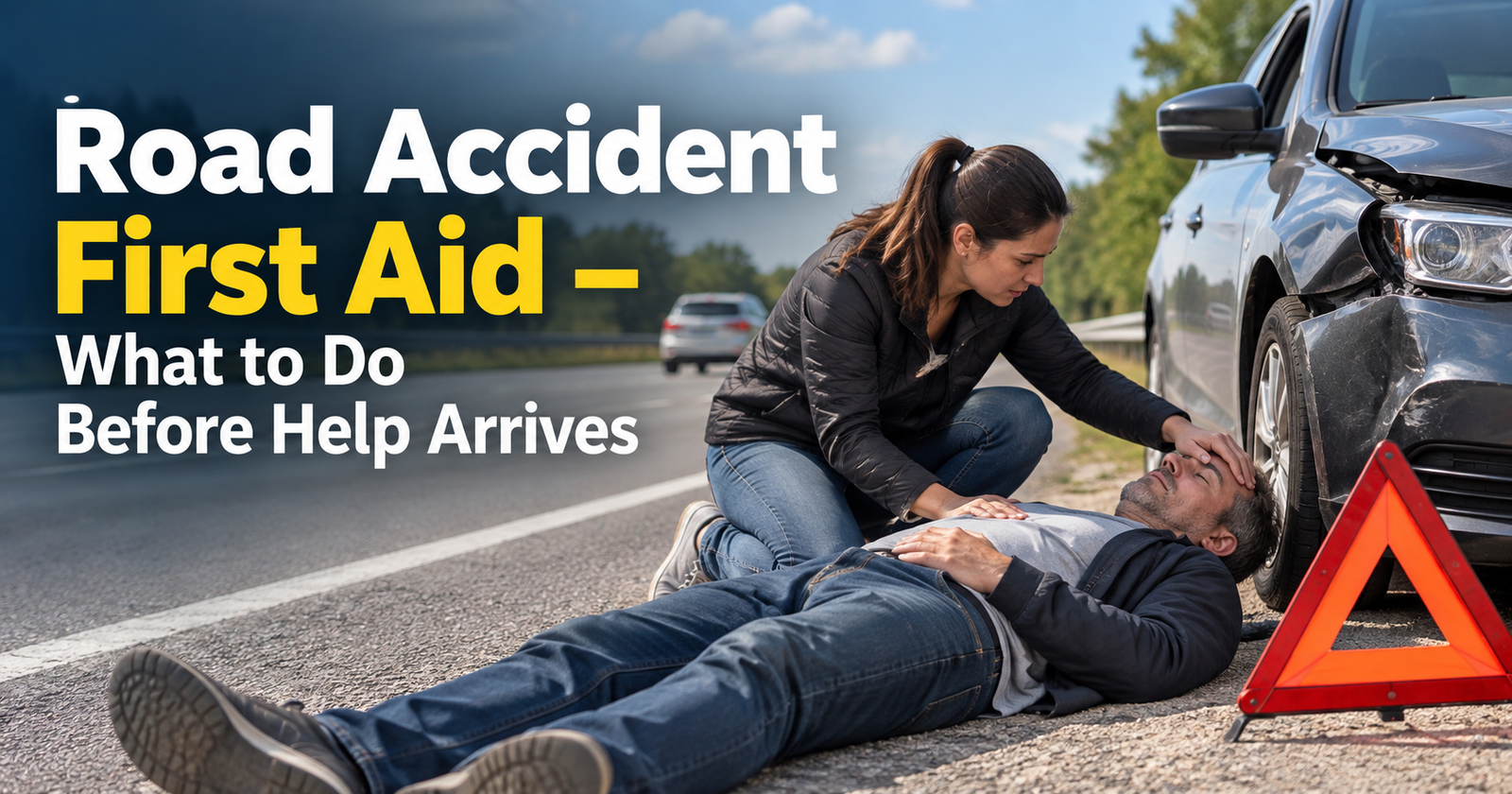
Road Accident First Aid: Simple Steps to Help Someone
A road accident can happen in seconds, but the first few minutes afterward are extremely important. People at the scene may be frightened, injured, bleeding, unconscious, or trapped inside a vehicle. Knowing basic road accident first aid can help you stay calm, protect yourself, and give useful support until emergency medical help arrives.
The purpose of first aid is not to replace doctors or paramedics. Your job is to keep the situation as safe as possible, identify immediate threats to life, call emergency services, and provide simple lifesaving care when needed.
This guide explains what to do after a road accident, what mistakes to avoid, and how to help an injured person safely while waiting for professional responders.
Knowing basic road accident first aid can help you respond safely during the critical minutes before emergency services arrive.
Make Sure the Accident Scene Is Safe

Before helping anyone, check the area around the crash.
Your own safety must come first. If you become injured while trying to help, emergency responders will have another casualty to manage.
Look for dangers such as:
- Moving traffic
- Fire or smoke
- Fuel leaking from vehicles
- Broken glass
- Fallen electrical wires
- Unstable vehicles
- Hazardous chemicals
- Vehicles that may suddenly roll or move
If you are driving when you see an accident, stop only if you can do so safely. Park away from moving traffic and turn on your hazard lights.
Do not stand in the road unless absolutely necessary. If the area is dangerous, keep a safe distance and call emergency services.
Never enter a vehicle that is burning or surrounded by dangerous fumes.
Call Emergency Services as Soon as Possible

In the United States, call 911. In other countries, use the local emergency number. If you are traveling, learn the emergency number for your location before an emergency occurs.
If other people are present, ask one specific person to make the call while you check the casualty. Instead of shouting for someone to call, point to a particular person and ask them directly.
Give the emergency dispatcher clear information.
Explain:
- Your exact location
- How many vehicles are involved
- Approximately how many people are injured
- Whether anyone is unconscious
- Whether someone is trapped
- Whether there is severe bleeding
- Whether there is fire, smoke, fuel, or another hazard
- Keep your phone on speaker if the dispatcher gives first aid instructions.
- Do not hang up until you are told it is safe to do so.
Check the Injured Person
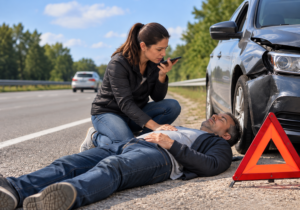
A quick road accident first aid assessment should focus first on breathing, responsiveness, and severe bleeding.
- Once the scene is safe, quickly assess the injured person.
- Speak clearly and loudly.
- Ask if they are okay.
- If they respond, tell them to stay still while help is coming.
- If they do not respond, check whether they are breathing normally.
- At the same time, look for severe bleeding.
Your first priorities are:
- Responsiveness
- Normal breathing
- Life-threatening bleeding
Do not spend several minutes examining small cuts while a person has a more serious problem.
Deal with the most dangerous problems first.
Learn basic first aid steps from the American Red Cross.
Avoid Moving the Casualty Unless Necessary
One of the most important road accident first aid rules is to avoid unnecessary movement.
Car and motorcycle crashes can cause injuries to the head, neck, back, and spine. Moving the casualty incorrectly may make some injuries worse.
Do not pull someone from a vehicle simply because they are injured.
Movement may become necessary if:
- The vehicle is on fire
- There is an immediate danger of explosion
- The casualty is exposed to moving traffic
- Their airway cannot be kept open
- CPR needs to be started
- Severe bleeding cannot otherwise be controlled
If there is no immediate danger and the person is breathing normally, encourage them to remain still.
Tell them that emergency help is on the way.
What to Do If the Person Is Unconscious but Breathing
- An unconscious person may not be able to protect their airway.
- Check carefully for normal breathing.
- If the casualty is breathing and there is no immediate danger, avoid unnecessary movement because a spinal injury may be present.
- Continue monitoring their breathing.
- If the airway becomes blocked, the person vomits, or they cannot maintain an open airway, turning them onto their side may become necessary.
- If you must turn them, try to keep the head, neck, and spine aligned as much as possible.
- Stay with the casualty until emergency responders arrive.
If you are unsure about CPR technique, review these CPR steps before an emergency happens.
What to Do If the Person Is Not Breathing Normally

- If an adult is unconscious and is not breathing normally, or is only gasping, start emergency care immediately.
- Call 911 or have someone else make the call.
- Begin CPR.
- If possible and safe, place the casualty on a firm, flat surface.
- Kneel beside them and place both hands in the center of the chest.
- Push hard and fast.
- Aim for approximately 100 to 120 chest compressions per minute.
- Allow the chest to rise fully after each compression.
- If you are trained to provide rescue breaths, use 30 chest compressions followed by 2 breaths.
- If you are not trained or are uncomfortable giving rescue breaths, continue hands-only chest compressions.
- If an automated external defibrillator is available, ask another person to bring it. Turn it on and follow the spoken instructions.
- Continue CPR until the casualty begins breathing normally, emergency responders take over, the scene becomes unsafe, or you are physically unable to continue.
Control Severe Bleeding Quickly

Controlling severe bleeding is one of the most important parts of road accident first aid.
Look for bleeding that is:
- Flowing continuously
- Spurting
- Pooling quickly
- Soaking through clothing
- Coming from a deep or large wound
Wear disposable gloves if available.
Place clean gauze, cloth, or another suitable material over the wound.
Apply firm, steady pressure directly over the bleeding area.
Do not keep lifting the dressing to see whether the bleeding has stopped. This can disturb blood clotting.
Continue applying pressure until the bleeding is controlled or emergency responders take over.
If the casualty is conscious and able to help, they may be able to press firmly on their own wound while you call for emergency assistance.
Knowing how to control life-threatening bleeding can be especially important after a serious crash.
Never Remove an Object Stuck in a Wound
Road accidents may cause pieces of glass, metal, or other objects to become embedded in the body.
Do not pull them out.
An embedded object may actually be helping to slow the bleeding.
Removing it can cause much heavier blood loss.
Instead:
- Leave the object in place
- Apply pressure around the wound
- Avoid pressing directly on the object
- Keep the casualty still
- Wait for professional medical help
Look for Signs of Internal Bleeding
Good road accident first aid also means watching for serious injuries that may not be visible from the outside.
The force of a collision can cause internal injuries even when there is little blood outside the body.
Warning signs may include:
- Pale or clammy skin
- Weakness
- Dizziness
- Confusion
- Rapid breathing
- Abdominal pain
- Swelling of the abdomen
- Chest pain
- Large areas of bruising
- Blood in vomit
- Blood when coughing
- Reduced responsiveness
Internal bleeding is a medical emergency.
Keep the person still and monitor their breathing.
Do not give them food or drink.
Watch for Shock
Serious injuries and blood loss can cause shock.
Shock happens when the body’s vital organs do not receive enough blood and oxygen.
Possible warning signs include:
- Pale skin
- Cold or clammy skin
- Fast breathing
- Weakness
- Dizziness
- Confusion
- Restlessness
- Weak or rapid pulse
- Reduced responsiveness
Keep the casualty as comfortable as possible.
Cover them with a coat or blanket to prevent them from becoming cold.
Continue monitoring their breathing and responsiveness.
Do not give food, water, alcohol, or medication.
Be Careful With Possible Head or Spinal Injuries
Head, neck, and spinal injuries can occur during high-impact road accidents.
Possible warning signs include:
- Severe neck pain
- Severe back pain
- Numbness
- Tingling
- Weakness in the arms or legs
- Difficulty moving
- Confusion
- Loss of consciousness
- Severe headache
- Unusual behavior
Tell the person not to move.
Do not attempt to straighten their neck.
Avoid sitting them up or helping them walk unless remaining in place creates a greater danger.
Wait for trained emergency personnel.
If Someone Is Trapped in the Vehicle
A person may become trapped inside or underneath a damaged vehicle.
Do not attempt complicated rescue procedures unless there is an immediate threat to life.
Never crawl underneath an unstable vehicle.
Do not try to lift a vehicle by yourself.
Tell emergency services that someone is trapped.
If you can safely reach the casualty, reassure them and encourage them not to move.
Continue checking their breathing and responsiveness until rescuers arrive.
What to Do If There Is Fire or Smoke
Fire can make an accident scene extremely dangerous.
If you see flames, heavy smoke, or signs of leaking fuel, move away from the vehicle.
Keep other people away as well.
Call emergency services immediately.
Do not smoke near the accident scene.
Do not use matches, lighters, or any open flame.
Do not return to a dangerous vehicle to collect personal belongings.
If a casualty is in immediate danger from fire and can safely be moved, moving them away from the danger may be necessary.
For more guidance on staying safe during a fire emergency, see our Fire Emergency Safety Guide
Motorcycle Accident First Aid
Motorcycle crashes have a particularly high risk of head and spinal injuries.
Do not remove a rider’s helmet just because they are injured.
Do not remove a motorcycle helmet unnecessarily. If the rider is not breathing normally or their airway cannot be maintained, emergency care may require helmet removal so CPR or airway support can be provided. If possible, have trained people remove the helmet while keeping the head and neck aligned. Call emergency services and follow the dispatcher’s instructions. Do not delay lifesaving care when it is urgently needed.
If the rider is conscious and breathing normally, encourage them to remain still.
Do not allow them to stand up immediately after a serious crash.
Common Road Accident First Aid Mistakes
Some well-intentioned actions can make the situation worse.
Avoid these common mistakes:
- Running into moving traffic
- Moving an injured person unnecessarily
- Pulling someone from a vehicle without a safety reason
- Giving the casualty food or water
- Removing objects from wounds
- Ignoring severe bleeding
- Leaving an unconscious casualty alone
- Assuming gasping is normal breathing
- Removing a motorcycle helmet without a clear reason
- Attempting complicated rescue techniques without training
- Allowing a crowd to surround the injured person
Simple, calm actions are usually more helpful than trying to do too much.
Quick Road Accident First Aid Checklist
Remember this simple order:
- Make sure the scene is safe.
- Call 911 in the United States, or your local emergency number elsewhere..
- Check whether the casualty responds.
- Check whether they are breathing normally.
- Look for severe bleeding.
- Start CPR if they are not breathing normally.
- Apply firm pressure to serious bleeding.
- Avoid unnecessary movement.
- Keep the casualty warm and reassured.
- Continue monitoring until professional help arrives.
What to Keep in Your Car First Aid Kit
Keeping basic road accident first aid supplies in your car can help you respond more safely during an emergency.
Useful items include:
- Disposable gloves
- Sterile gauze pads
- Trauma dressings
- Roller bandages
- Adhesive tape
- Adhesive bandages
- Emergency blanket
- CPR face shield
- Scissors
- Flashlight
- High-visibility vest
- Basic first aid guide
Check the kit regularly and replace damaged or expired supplies.
Frequently Asked Questions
Should I pull an injured person out of a crashed vehicle
Usually no. If the person is breathing and there is no immediate danger, avoid unnecessary movement. Wait for trained rescuers unless fire, traffic, or another serious hazard makes movement essential.
Should I give water to an accident victim
No. A seriously injured person should not be given food or drink while waiting for emergency medical care.
What should I do if someone is bleeding heavily
Apply firm pressure directly to the wound and call 911. Continue pressure until emergency responders arrive.
What if the casualty says they feel fine
Do not automatically assume there is no injury. Some head injuries and internal injuries may not be obvious immediately. A serious crash should still be taken seriously.
Final Thoughts
Road accident first aid is about doing a few important things correctly during the critical minutes before professional help arrives.
Protect yourself first. Make sure the scene is safe. Call emergency services quickly. Check responsiveness and breathing. Control severe bleeding. Start CPR when necessary and avoid moving casualties unnecessarily.
You do not need to perform complicated medical procedures to be helpful. Staying calm, recognizing life-threatening problems, and providing basic first aid can make a meaningful difference until emergency professionals take over.
Learning certified first aid and CPR is one of the best ways to prepare yourself for emergencies and build the confidence to act when someone urgently needs help.
1 thought on “Road Accident First Aid: Simple Steps to Help Someone”